We have compiled a list of manufacturers, distributors, product information, reference prices, and rankings for Measures against moisture and condensation.
ipros is IPROS GMS ・ IPROS One of the largest technical database sites in Japan that collects information on.

Measures against moisture and condensation - List of Manufacturers, Suppliers, Companies and Products | IPROS GMS

Measures against moisture and condensation Product List

1~2 item / All 2 items

Displayed results

Moisture and condensation countermeasure "Silica Clean"

Excellent moisture-regulating effect, a material that adjusts humidity! Prevents mold and odors, and protects your room from deterioration!

"Silica Clean" is a moisture and condensation control sheet that boasts a moisture absorption capacity of approximately 300ml per 1m². The silica used as a raw material is a safe and secure substance that makes up 60% of the Earth's crust, allowing for use anywhere. The maximum moisture absorption capacity for an 8-tatami room (32.4m³) can reach up to 1240ml based on calculations. By simply placing this product over about 6m², you can prevent mold and odors, as well as protect your room from deterioration. Additionally, it is recommended to circulate the air using a ventilation fan during this time. [Product Lineup] ■ PP Type [Polypropylene Type] ■ PE Type [Polyester Type] ■ Silica Clean / Fabric Panel *For more details, please refer to the PDF document or feel free to contact us.

  • Other safety and hygiene products
  • Measures against moisture and condensation

Added to bookmarks

Bookmarks list

Bookmark has been removed

Bookmarks list

You can't add any more bookmarks

By registering as a member, you can increase the number of bookmarks you can save and organize them with labels.

Free membership registration

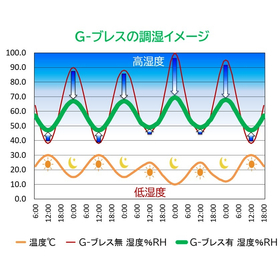
The malfunction may be caused by humidity! For malfunction countermeasures and maintenance, G-Breath.

Even with a waterproof structure, the internal temperature can drop by just a few degrees, leading to high humidity and condensation. Are you using it beyond the specified humidity range of the product?

I never imagined that the cause of the malfunction would be "humidity"! The product has a waterproof structure with a specified humidity range of 20% to 80%. During daytime inspections, the internal temperature was 25°C and the humidity was 60%, which is an acceptable environment. However, it malfunctioned later. Upon investigating the cause, I found that the humidity inside had risen at night! Why? At a temperature of 25°C and humidity of 60%, the dew point temperature at which condensation begins is 16°C. Just a few degrees drop in temperature can lead to high humidity and condensation. (Relative) humidity % = Actual amount of water vapor in the air / Amount of water vapor that can be held in the air (saturated water vapor amount) x 100. The saturated water vapor amount in the denominator decreases as the temperature drops and increases as the temperature rises. Therefore, even if the amount of water vapor in the air does not change, if the temperature drops, the humidity will rise. Conversely, if the temperature rises, the humidity will drop, making it a phenomenon that is not easily noticed. The humidity inside the product fluctuates between medium to high humidity levels, potentially exceeding the specified humidity range of the product. Without knowing this situation, damage can occur, leading to sudden malfunctions (such as poor contact, power loss, decreased insulation resistance, etc.) one day. Especially in infrastructure facilities, a malfunction of just one piece of equipment cannot be overlooked. Problems can arise whether the humidity is too high or too low.

  • Board materials
  • Other packaging materials
  • Dehumidifier
  • Measures against moisture and condensation

Added to bookmarks

Bookmarks list

Bookmark has been removed

Bookmarks list

You can't add any more bookmarks

By registering as a member, you can increase the number of bookmarks you can save and organize them with labels.

Free membership registration